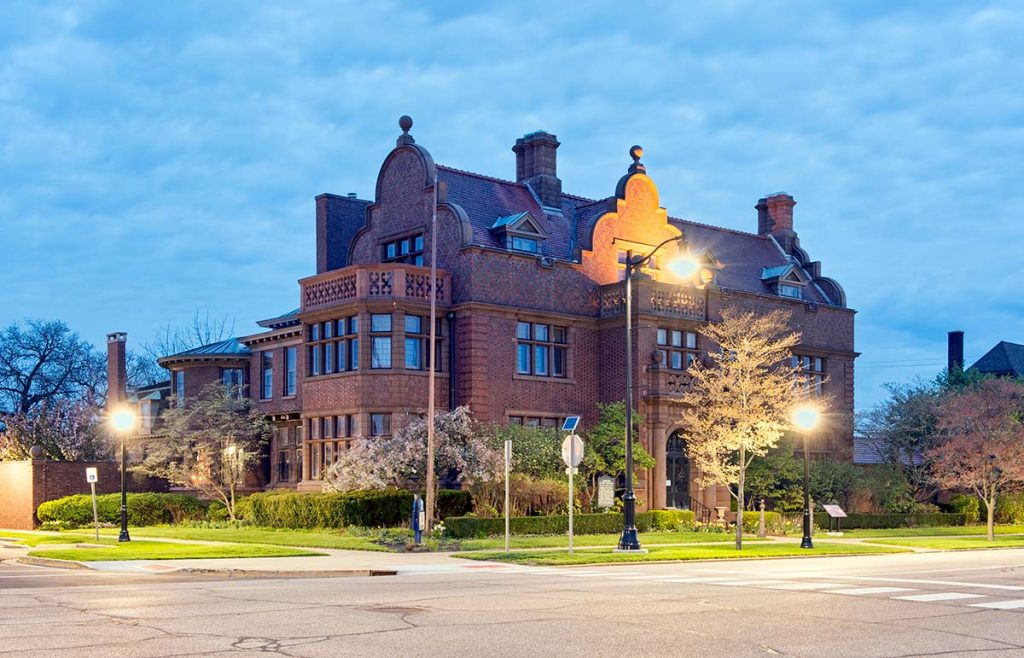
The Mansion is the outstanding legacy of the Barker heritage, telling the story of the family’s great success and of the Haskell & Barker Car Company. This building stands as a tribute to the industrialist John H. Barker, whose hard work and innovations revolutionized freight car manufacturing in the late 19th century.
This tour will take you throughout the house and highlight interesting historical aspects of each room. Unlike many house museums, nearly all of what you will see originally belonged to the Barkers. Their family home will offer you an in-depth look into their life in Michigan City and the styles of the late Victorian Era.
The Mansion, designed in the style of an English manor house, was built within walking distance of the Haskell & Barker Car Works. More than a century later, the house and the former site of the Car Works form a historic district. The Mansion draws visitors as a Victorian period home, and updated amenities make it a striking setting for meetings, exhibits, civic functions and special events.
About the Barkers and the Haskell & Barker Car Co.
The Barker family story in Michigan City begins with John Barker's arrival as a young man from Andover, Massachusetts, in 1836. While working to establish himself, he married Cordelia Collamer of Sandy Hill, New York, in 1841. They had five children, three of whom survived into adulthood: John H., Wallace, and Anna S.
Mr. Barker was successful as a general merchant, then became a grain broker, and subsequently, owner of a commission house receiving and forwarding merchandise from ships on the Great Lakes. At the onset of the railroad age, he saw an opportunity in the freight car business, and in 1855, bought an interest in a small freight car manufacturing plant. In 1858, it became the Haskell & Barker Car Company.
Government contracts during the Civil War years caused the business to prosper and become an important factor in the growth of Michigan City. In 1869, the senior Mr. Barker retired, and his son, John H., who was in business in Chicago, became General Manager of Haskell & Barker. After becoming president in 1883, his business skills and the favorable economic climate made the company a phenomenal success. By 1908, its annual building capacity grew to 15,000 freight cars. Mass production methods were introduced at the Car Works fifty years before being refined and instituted by Henry Ford and others.
John H. was not as fortunate in his personal life as in business. During his 18-year first marriage, he and his wife Genia (Brooks) lost their three children as infants, and Genia died soon after. In 1893, he married Katherine Fitzgerald who came to the city to teach at Barker Hall. Their only child, Catherine, was born in 1896.
John H. and Katherine died only months apart in 1910, leaving their daughter an orphan. Mr. Barker’s estate was valued between twenty five to thirty million dollars, making Catherine an immensely wealthy heiress at age 14.
The Barker family created a legacy of philanthropy, and there are many examples of their support in Michigan City. During their lifetime, John H. and Katherine’s contributions to the community included a major gift to found Michigan City’s first public library, as well as funds for St. Anthony’s Hospital, Barker Hall, Trinity Cathedral (now Trinity Episcopal Church), the first Y.M.C.A, and the municipal bandstand in Washington Park. Their daughter Catherine established the Barker Annuity Fund to provide pensions for retired Haskell & Barker employees after the company was merged with the Pullman Car Company in 1922. And in 1934, she founded The Barker Welfare Foundation, which continues to support community organizations in Michigan City and around the country. Catherine had four children with her husband, Charles V. Hickox. Their children, grandchildren and great-grandchildren are active in the Foundation today.
Catherine Barker Hickox died on November 18, 1970, at her home on Long Island, New York. She and her husband are buried with the Barkers in Michigan City’s Greenwood Cemetery.


