As a guest of the family, you would have been graciously received in the elegantly appointed Drawing Room. This was the social hub of the mansion, the public room where both men and women would be welcome and entertained.
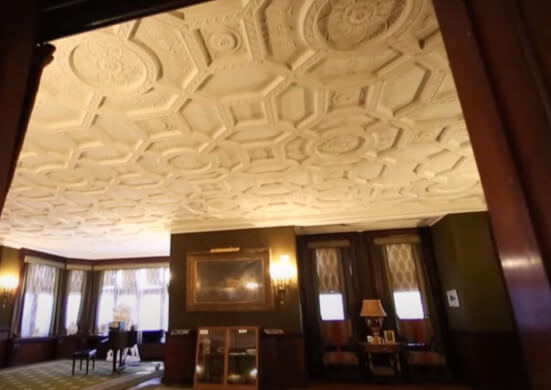
The impressive ceiling, crafted in the Baroque style and fashioned from horsehair plaster, bears intricate hand-stamped designs. Notably, the stamp mold, a customary inclusion for potential repair purposes, discreetly resides within the ceiling, a testament to the meticulous craftsmanship of the era. Much of the Drawing Room stems from the 1905-1909 expansion of the house, showcasing the evolution of architectural tastes and styles.
Adjacent to the Dining Room doorway, a small nook with two windows remains as a vestige of the older home, contrasting with the expanded dimensions of the Drawing Room. This asymmetry, evident in the room's layout and the positioning of the fireplace, reflects the blending of old and new architectural elements, providing a unique character to the space while honoring the historical context of the residence.
Dominating the room is a large marble statue, a reproduction of Antonio Canova's (1757-1822) renowned masterpiece, "The Three Graces." Depicting the mythological Greek goddesses Euphrosyne, Aglaea, and Thalia, the sculpture embodies attributes of mirth, elegance, and youth/beauty respectively. Canova's portrayal emphasizes a harmonious unity among the three figures, a theme frequently noted by art historians for its serene balance.
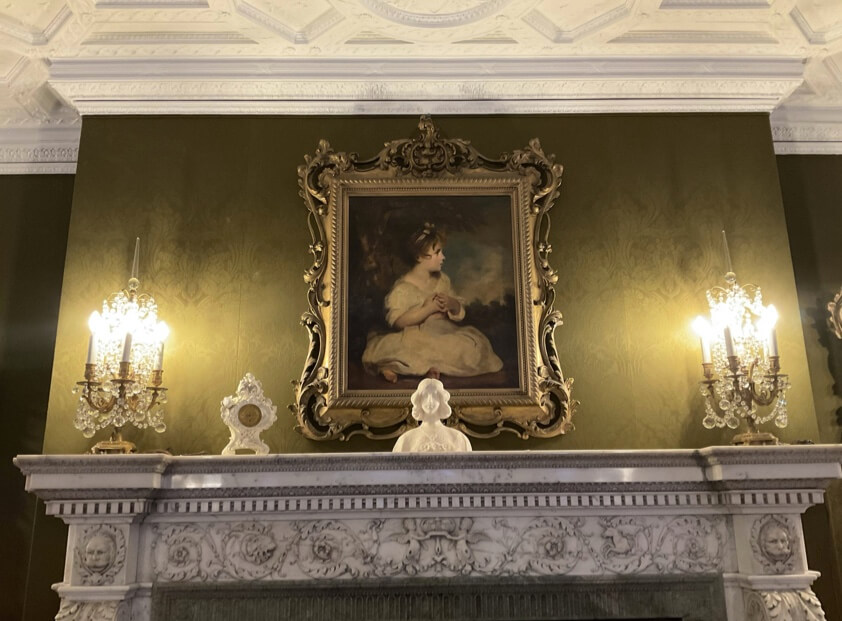
The mantel, crafted from Italian marble, serves as another noteworthy feature of the Drawing Room. Remarkably, the face of John H. Barker is intricately carved on either side, a customary practice of craftsmen to honor benefactors who commissioned significant works. This personal touch adds a layer of historical significance and tribute within the room's decor.
Additionally, the Drawing Room boasts the presence of "The Three Musicians of the Renaissance," a statue gifted to Mr. & Mrs. William Walter and Georgiana Vail by the Barkers as a housewarming gesture. Subsequently returned to the estate by the Walter and Vail families, this sculpture enriches the room, serving as a testament to the enduring connections between families and their shared appreciation for art and craftsmanship.
The relocation of the 1906 Steinway piano from the third floor to its original place in the Drawing Room holds significant historical and sentimental value for the family. The piano, a gift for Catherine Barker’s tenth birthday, is not only a remarkable instrument but also a tangible link to the mansion's rich past and the Barker family's legacy. The piano was set in the Drawing Room during the years when Catherine presided over the mansion, then traveled with her to New York where her children and grandchildren played on it. The decision to return the Steinway piano to its rightful place in the Drawing Room wasn't merely a matter of shifting furniture. It symbolized a restoration of tradition, a reconnection with the past, and a reaffirmation of the importance of preserving family heritage.